
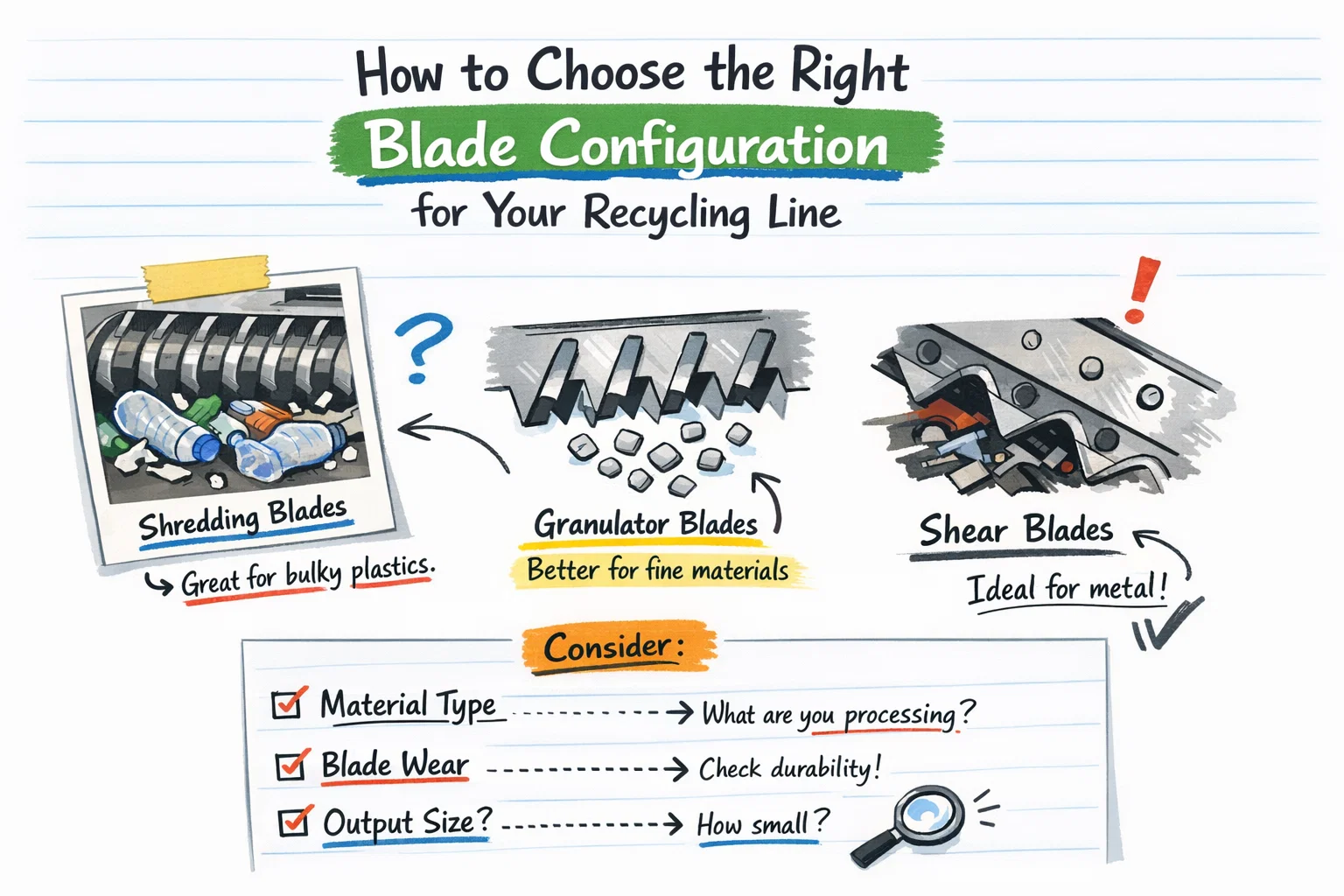
El rendimiento de la maquina cortadora de botellas de plastico es a menudo la primera “puerta de calidad” real en una linea de botella a hojuelas. Si el material de la hoja, la geometria del rotor y el espacio libre de corte no coinciden con su materia prima, pagara por ello mas adelante en el proceso con un tamano de escamas inconsistente, mayor cantidad de polvo, danos por fusion y tiempo de inactividad evitable. Esta guia explica como comparar los aceros para hojas (SKD-11 frente a D2), como se comportan los disenos de garra frente a hojas planas y como ajustar el corte para botellas de PET frente a HDPE para que toda la linea funcione de manera mas predecible.
Si esta evaluando un enfoque de corte humedo que combina la reduccion de tamano con lavado y enfriamiento en la camara, consulte esta pagina trituradora humeda de botellas de plastico para conocer el flujo de trabajo de granulacion humeda y una tabla de especificaciones de referencia.
Lo que realmente necesita hacer una maquina cortadora de botellas de plastico (en terminos de proceso)
El trabajo de un cortador no es simplemente “hacer piezas mas pequenas”. En una linea de reciclaje, la cortadora debe entregar:
- Distribucion estable del tamano de particulas (la geometria consistente de las escamas ayuda al lavado, flotacion y secado)
- Bajo nivel de finos y polvo (los finos cargan los filtros, reducen el rendimiento y pueden aumentar el flujo posterior mantenimiento)
- Generacion de calor controlada (el sobrecalentamiento puede ablandar los plasticos y manchar los contaminantes)
- Rendimiento predecible sin atascos repetidos
- Desgaste reparable piezas con intervalos de cambio realistas y procedimientos rapidos de reemplazo de cuchillas
Si especifica una maquina para su adquisicion, la decision suele ser sobre el riesgo: riesgo de tiempo de actividad, riesgo de calidad y riesgo de mantenimiento.
Decision basada en la materia prima: botellas de PET versus HDPE (y que cambios para el cortador)
La configuracion de la hoja debe comenzar con el material de la botella y el perfil de contaminacion, no con un numero de modelo.
Botellas de PET (mayor rigidez, tendencia quebradiza en frio)
Preocupaciones tipicas sobre el cortador:
- Mas fracturas tipo “grietas” si el corte es demasiado agresivo, lo que puede generar multas.
- Las etiquetas y el adhesivo pueden mancharse si la temperatura de corte aumenta.
Lo que normalmente ayuda:
- Retencion de bordes afilados y estables y buena resistencia al desgaste.
- Espacio libre de corte estable para que la maquina no comience a rasgar en lugar de cortar.
- Un diseno que reduce los ciclos repetidos de corte que triturar el material hasta convertirlo en polvo.
Botellas de HDPE (mas resistentes, mas ductiles)
Preocupaciones tipicas sobre el cortador:
- Los plasticos ductiles pueden “tirar” y estirarse en lugar de cortarse limpiamente, especialmente con hojas desafiladas.
- Riesgo de enrollarse alrededor del rotor si la geometria y la seleccion de la pantalla no son correctas.
Lo que normalmente ayuda:
- Geometria de la hoja que admite corte constante, sin desgarro.
- Una configuracion que controla el “cordon” y reduce la posibilidad de que se formen puentes en la pantalla.
- Un plan de mantenimiento que mantiene las hojas lo suficientemente afiladas para evitar tirones y calentamiento.
Rumtoo normalmente ve que los compradores subestiman la rapidez con la que el estado del filo de una cortadora afecta a toda la linea de lavado. El cortador es un apalancamiento aguas arriba para la estabilidad aguas abajo, por lo que merece una seleccion de nivel de ingenieria en lugar de un pedido de “configuracion estandar”.
Estructura de la hoja: garra (escalonada) vs plana (recta): en que se diferencia la mecanica
Ambos disenos pueden funcionar, pero se comportan de manera diferente bajo carga y con alimentacion mixta.
| Factor de seleccion | Hoja de garra (escalonado) | Hoja plana (recta) |
|---|---|---|
| Compromiso comportamiento | Mordida progresiva en formas irregulares, a menudo perfil de torsion mas suave | Mas compromiso «todo a la vez», puede ser estable si se controla la alimentacion |
| Mejor ajuste Materia prima | Formas de botella mixtas, espesor de pared inconsistente, piezas huecas livianas | Alimentacion estable y controlada para lograr una geometria de escamas consistente |
| Calidad principal Riesgo | Desgarro en plasticos ductiles si la holgura y el filo se desvian | Desgarro y aumento de calor si las cuchillas se desafilan o se acelera el avance |
| Como se muestran los problemas arriba | Mas encordado, mas finos si el recorte aumenta | Picos de carga del motor mas altos, mas finos cuando el corte se convierte en desgarro |
| Controles que importan | Liquidacion estabilidad, disciplina de nitidez, control de contaminacion | Estabilidad de alimentacion, estabilidad de separacion, coincidencia de pantalla |
Guia rapida
- Elija cuchillas de garras cuando la consistencia del alimento sea la principal limitacion y necesite un comportamiento de mordida mas suave.
- Elija cuchillas planas cuando la uniformidad de salida sea el requisito principal y pueda controlar la alimentacion y el espacio libre. firmemente.
Comparacion del material de la hoja: SKD-11 vs D2 (lo que puedes comparar con seguridad)
SKD-11 y D2 a menudo se tratan como totalmente diferentes. En la practica, ambos son aceros para herramientas con alto contenido de carbono y cromo que se utilizan cuando se necesita resistencia al desgaste. Para la adquisicion, la etiqueta de calidad importa menos que la consistencia del tratamiento termico, la estabilidad de los bordes y como el proveedor respalda el afilado y los repuestos.
| Pregunta de decision | Que confirmar (para SKD-11 o D2) | Por que es importante en una maquina cortadora de botellas de plastico |
|---|---|---|
| ¿El borde permanecera estable bajo abrasivo? ¿Contaminacion? | Enfoque de tratamiento termico y rango de dureza objetivo, ademas de expectativas de desgaste de bordes del mundo real | El desgaste de los bordes cambia desde el corte hasta el desgarro, generando finos y calor |
| ¿Que probabilidad hay de que se astillen los objetos duros? entrar? | Guia de dureza, contaminacion permitida y recomendaciones de proteccion aguas arriba | El desconchado puede causar vibracion, mala calidad de corte y rapido aumento del dano |
| ¿Cuantos reafilados son realistas? | Limites de afilado, espesor minimo y coincidencia reglas (individuales o en conjunto) | Controla el costo de vida util y ayuda a planificar las ventanas de tiempo de inactividad |
| ¿Puede mantener el tiempo de actividad predecible? | Disponibilidad de juegos de repuesto, plazo de entrega y piezas de desgaste estandar list | El tiempo de inactividad a menudo se debe a los repuestos, no a la mano de obra |
Logica de seleccion practica
- Si su prioridad es vida util del borde bajo contaminacion abrasiva (suciedad, arena, fragmentos de vidrio, finos metalicos), priorice resistencia al desgaste y tratamiento termico estable.
- Si su prioridad es tolerancia al impacto (objetos duros que ocasionalmente entran en el cortador), priorice resistencia al desconchado y planifique un estricto control de la contaminacion aguas arriba.
Que preguntar a los proveedores para evitar sorpresas
- Enfoque de tratamiento termico y rango de dureza objetivo
- Limites de afilado de la hoja (espesor minimo o ciclos maximos de afilado)
- Establecer estrategia de reemplazo (hoja unica versus juego combinado)
- Lista de piezas de desgaste esperadas y recomendadas paquete de repuestos
Si no puede obtener respuestas claras, tratelo como un riesgo de mantenimiento y fijelo en su decision.
Optimizacion de corte: parametros clave que debes especificar y controlar
Una cortadora que funciona bien suele ser el resultado de ventanas operativas estables. Los siguientes parametros son de donde realmente provienen la mayoria de los “problemas misteriosos”.
1) Espacio libre de corte (espacio) y alineacion
Sintomas de autorizacion incorrecta:
- Exceso de finos y polvo
- Mayor corriente y temperatura del motor
- Mas ruido y vibracion
- Manchas de etiquetas/adhesivo en dias calidos
Controles:
- Requiere un procedimiento de alineacion claro.
- Asegurese de que el diseno de la maquina permita verificar y restablecer el espacio libre rapidamente.
2) Estrategia de pantalla (o dimensionamiento)
Una pantalla demasiado restrictiva:
- Fuerza a volver a cortar.
- Aumenta el calor.
- Aumenta las multas.
Una pantalla demasiado abierta:
- Produce piezas de gran tamano que pueden perjudicar la eficiencia del lavado y la separacion.
Especifique el tamano de la criba segun sus requisitos posteriores (lavadora, separacion por hundimiento y flotacion, secadora), no solo segun el estandar del catalogo de la cortadora.
3) Velocidad del rotor y estabilidad del avance
Una velocidad mas alta puede aumentar el rendimiento, pero tambien puede:
- Aumentar la generacion de calor.
- Aumentar las multas por impactos repetidos.
La estabilidad de la alimentacion es importante porque la alimentacion inconsistente crea picos de torsion, lo que acelera el dano de los bordes y la tension en los rodamientos.
4) Tolerancia a la contaminacion y proteccion aguas arriba
Si esperas:
- Clips de metal
- Vidrio
- Piedras
- Exceso de arena
Luego especifique los pasos ascendentes como:
- Deteccion de iman o metal cuando corresponda
- Preclasificacion o prelavado para reducir la arena
- Un plan de rechazo (como se protege el cortador de objetos duros)
Piezas de desgaste, mantenimiento y riesgo de tiempo de actividad (lo que deberia preocupar a adquisiciones)
El costo total de una cortadora generalmente depende del mantenimiento. Puntos clave para definir desde el principio:
- Tiempo de cambio del juego de cuchillas: cuanto tiempo lleva con herramientas normales y operadores capacitados
- Plan de afilado: si las cuchillas se afilan internamente o se envian out
- Estrategia de cuchillas de repuesto: al menos un juego de repuesto para reducir el tiempo de inactividad
- Otras piezas de desgaste: criba, cojinetes, sellos y cuchillas fijas
Modos y senales de fallo comunes
- Las multas aumentan: normalmente la hoja se embota o se desplaza el espacio libre
- La corriente del motor tiende a aumentar: condicion del borde, restriccion de la pantalla o avance inestabilidad
- Calentamiento u olor del material: corte excesivo, cuchillas desafiladas o velocidad demasiado alta
- Atascamientos y puentes: falta de coincidencia de la pantalla, mala alimentacion o material ductil encadenamiento