
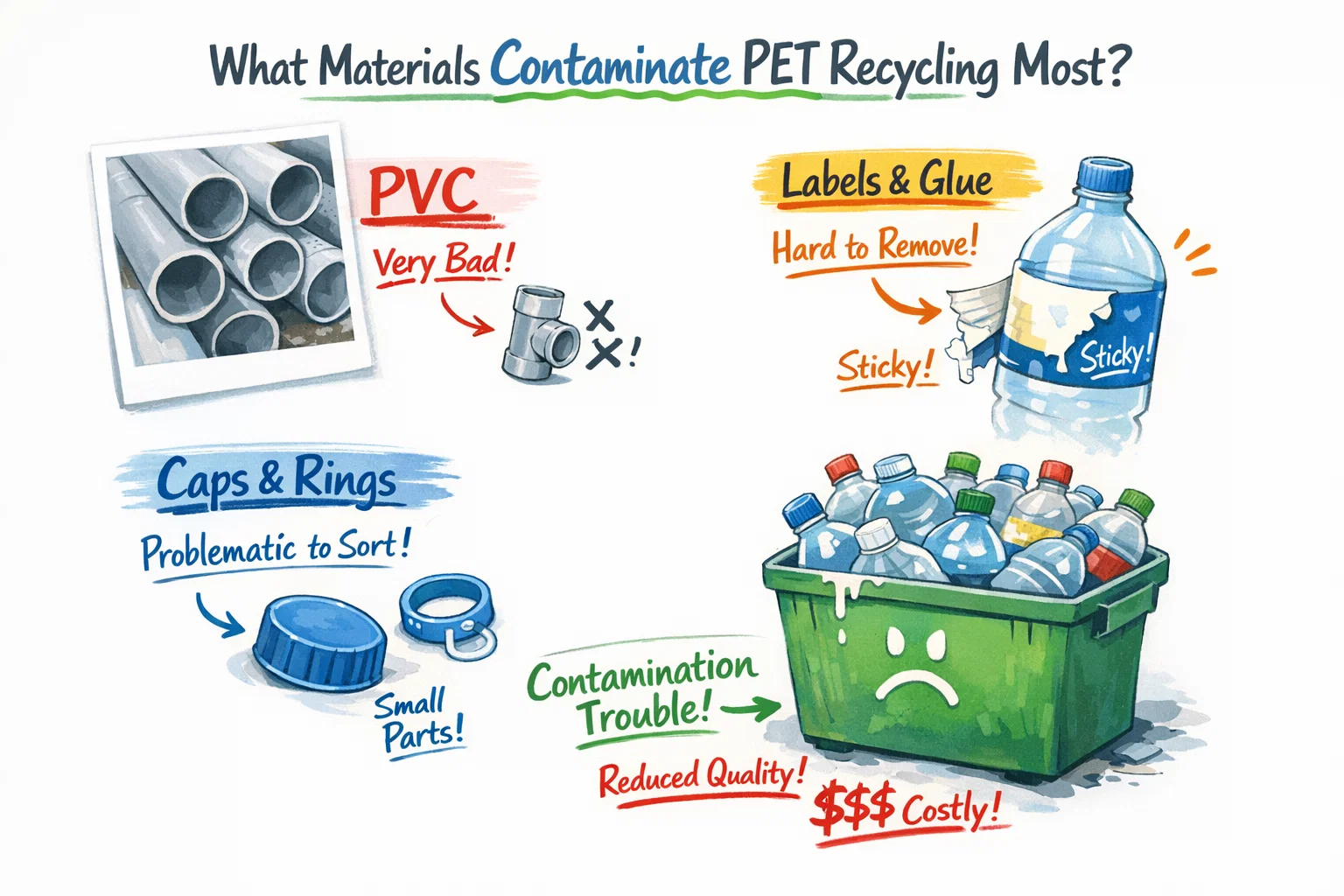
What materials contaminate PET recycling the most
If you produce high value rPET flake or bottle to bottle feedstock the biggest risk is not dirt It is the wrong material entering the stream or residues that stay on the PET These contaminants can cause yellowing black specks odor lower IV and costly rejected lots The four most common sources are PVC labels adhesives and the cap system
This guide answers three practical questions
- Where each contaminant enters the stream
- How to identify it quickly at receiving and on the line
- How to remove it using proven process steps
A baseline target to keep in mind
Many premium buyers expect PVC to be controlled at very low ppm levels If you miss this target melt processing becomes less stable and final product aesthetics and properties degrade
On the PET bottle washing line for high purity rPET flake PVC content total impurity and glue content are treated as core quality indicators For example the page lists targets such as PVC below 50 ppm and total impurity below 100 ppm
Contaminant 1 PVC the batch killer
Common sources of PVC
- Whole PVC bottles or containers that look similar to PET
- PVC shrink sleeves or PVC based label material
- Specific closure components such as tamper seals or liners in certain markets
Fast identification on the floor
- Trained manual sorters can often spot suspect containers by look and handling cues and remove them before size reduction
- For automated sorting use material recognition systems such as NIR and add chlorine sensitive sorting where appropriate to build redundancy at critical points
Removal strategy inside the process
- Remove whole PVC items during pre sort This is the highest return step
- Improve de sleeving and label removal before granulation so PVC sleeves do not break into many small fragments
- If the incoming bale quality is variable add a second protection step after granulation to clean the flake stream
For a deeper explanation of why PVC triggers degradation and yellowing at processing temperatures and how to build a control program see this related article[2]
Contaminant 2 Labels paper film and full body sleeves
Labels are not only a materials problem They also introduce inks fibers and fine light fraction
What labels do to rPET flake
- Light fraction raises total impurities ppm
- Ink can bleed or migrate during washing which reduces clarity and color stability
- Paper fibers can create black specks and increase melt filtration load
Identification and separation keys
- At infeed remove obvious whole sleeves when possible
- After granulation use air classification to pull light label fragments away from heavier PET flake This is the most common and stable solution
- For stubborn sleeves and film labels use wet friction de labeling or a dedicated label removal stage earlier in the line
The PET bottle recycling machine with air classification label separation includes a label separation stage using air classification to remove lighter label material from PET flake
Contaminant 3 Adhesives hot melt pressure sensitive glue and residues
Adhesives are a classic cause of flake that looks clean but fails during extrusion because adhesive specks create defects odor and filtration problems
Why adhesives are difficult
- Cold washing rarely removes adhesive completely
- Adhesive can interact with ink and create color variability
The core removal approach
- Hot caustic washing is the primary tool Use temperature residence time chemistry and agitation to detach adhesive from PET surfaces
- Friction washing adds mechanical scrubbing to remove stubborn residues
- Strong rinsing is required to prevent re deposition of dissolved or detached contaminants
APR technical guidance and screening procedures emphasize that label and adhesive behavior under hot caustic wash conditions strongly affects rPET quality and that label residues and inks can become contamination and discoloration sources[3]
Contaminant 4 Caps and closure rings PP PE and liners
Most beverage caps are PP or PE Their lower density gives recyclers a reliable physical separation tool
Risks when caps remain in the PET stream
- PP and PE in PET flake reduce clarity and can increase haze
- Liners and sealing components can add additional contamination risk
The engineering solution
- Sink float separation is the foundation PET sinks while PP and PE float and can be continuously removed
- Stabilize flake size and control turbulence to reduce PET carryover into the float fraction
- Follow with a final air separation or screening step to remove remaining light fraction and fines
The PET washing line with sink float separation for caps removal highlights sink float separation as a key step to remove caps and other polyolefin contamination and protect flake purity
A practical contamination control workflow
- Incoming inspection
- Sample bales and record sleeve rate non PET rate metals glass and dirt
- Define downgrade or rejection thresholds and enforce them consistently
- Pre processing
- Debaling plus trommel screening to remove stones glass and heavy fines
- Manual pre sort to remove obvious PVC and non PET containers
- De labeling and size reduction
- Remove sleeves early whenever possible
- Use wet granulation as a pre wash to reduce load on downstream washing
- Light fraction removal
- Air classification to remove label fragments
- Density separation
- Sink float to remove PP and PE caps and rings
- Hot wash and friction wash
- Treat adhesives and oils as primary targets Control temperature time and chemistry
- Rinsing dewatering and drying
- Prevent re deposition and chemical carryover
- Quality verification
- Track PVC ppm moisture and total impurities ppm as routine KPIs
Troubleshooting checklist
- PVC ppm rises suddenly
- Check if a high sleeve or wrong bottle batch entered receiving
- Verify sorter calibration and air jet timing if optical sorting is used
- Black specks increase
- Verify adhesive removal and confirm no re deposition after hot wash
- Check water filtration and purge routines in recirculation loops
- Haze increases
- Check sink float separation stability and PET carryover
- Confirm air separation efficiency on film and light fraction
Equipment pathway
If your feedstock has heavy sleeves high adhesive load or frequent PVC risk the fastest route to higher purity is a strong sequence of de labeling air separation sink float separation and hot washing supported by routine testing
You can start with the complete PET bottle recycling machine and washing line solution to review a typical line layout and quality targets and then match each stage to your feedstock profile