
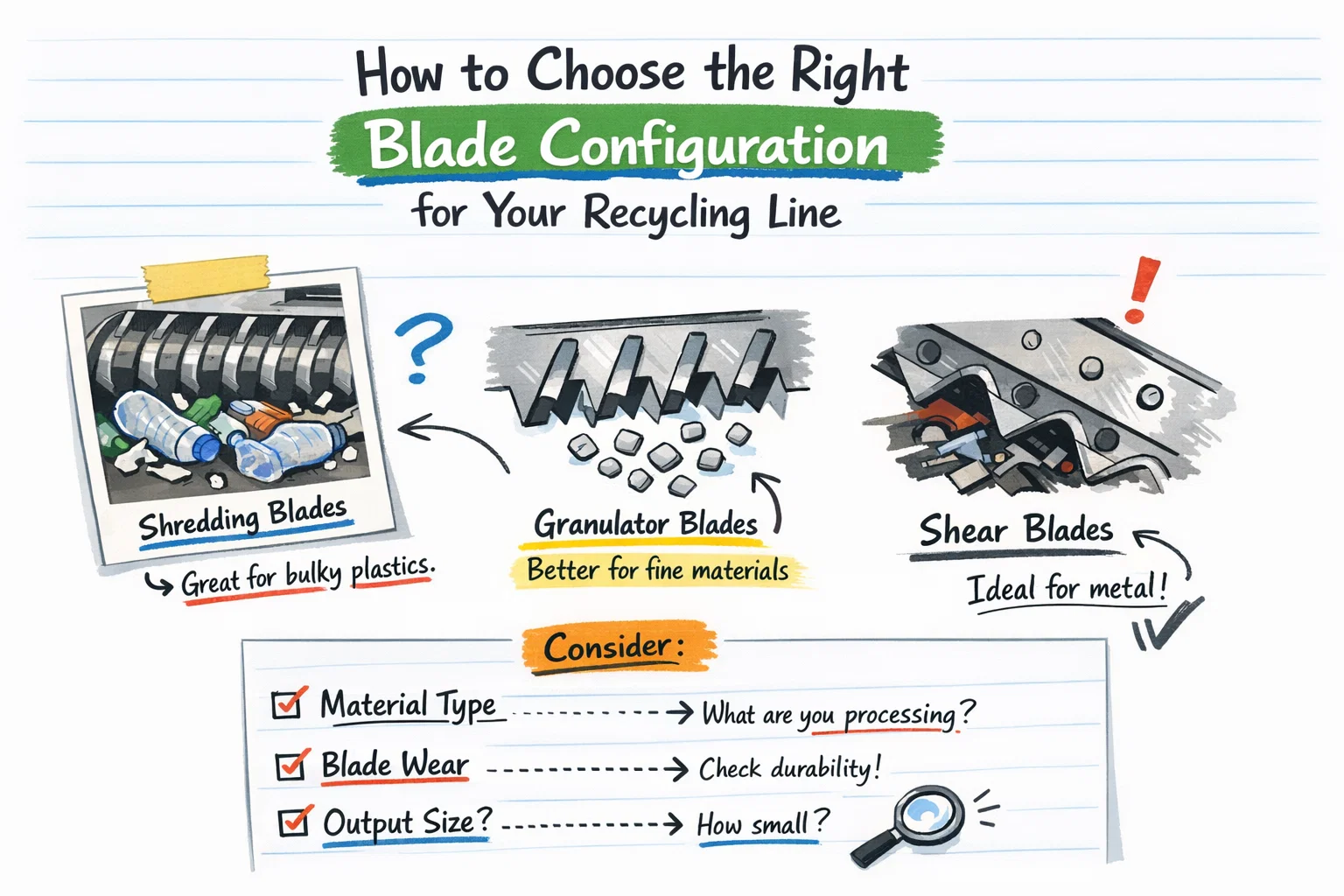
Plastic bottle cutter machine performance is often the first real “quality gate” in a bottle-to-flake line. If blade material, rotor geometry, and cutting clearance are mismatched to your feedstock, you will pay for it later in the process with inconsistent flake size, higher dust, melt damage, and avoidable downtime. This guide explains how to compare blade steels (SKD-11 vs D2), how claw vs flat blade designs behave, and how to tune cutting for PET vs HDPE bottles so the whole line runs more predictably.
If you are evaluating a wet cutting approach that combines size reduction with in-chamber washing and cooling, see this plastic bottle wet crusher page for the wet granulation workflow and a reference spec table.
What a plastic bottle cutter machine actually needs to do (in process terms)
A cutter’s job is not just “make pieces smaller.” In a recycling line, the cutter should deliver:
- Stable particle size distribution (consistent flake geometry helps washing, sink-float, and drying)
- Low fines and dust (fines load filters, reduce yield, and can increase downstream maintenance)
- Controlled heat generation (overheating can soften plastics and smear contaminants)
- Predictable throughput without repeated jams
- Serviceable wear parts with realistic change intervals and fast blade replacement procedures
If you are specifying a machine for procurement, the decision is usually about risk: uptime risk, quality risk, and maintenance risk.
Feedstock-driven decision: PET vs HDPE bottles (and what changes for the cutter)
Blade configuration should start with the bottle material and the contamination profile, not with a model number.
PET bottles (higher stiffness, brittle tendency when cold)
Typical cutter concerns:
- More “crack-like” fracture if the cut is too aggressive, which can raise fines.
- Labels and adhesive can smear if cutting temperature rises.
What usually helps:
- Sharp, stable edge retention and good wear resistance.
- Stable cutting clearance so the machine does not start tearing instead of shearing.
- A design that reduces repeated re-cutting cycles that grind material into dust.
HDPE bottles (tougher, more ductile)
Typical cutter concerns:
- Ductile plastics can “pull” and stretch instead of cleanly shearing, especially with dull blades.
- Risk of wrapping around rotor if geometry and screen selection are off.
What usually helps:
- Blade geometry that supports consistent shearing, not tearing.
- A configuration that controls “stringing” and reduces the chance of bridging at the screen.
- A maintenance plan that keeps blades sharp enough to avoid pulling and heating.
Rumtoo typically sees buyers underestimate how quickly a cutter’s edge condition affects the whole washing line. The cutter is upstream leverage for downstream stability, so it deserves engineering-level selection rather than “standard configuration” ordering.
Blade structure: Claw (staggered) vs Flat (straight) — how the mechanics differ
Both designs can work, but they behave differently under load and with mixed feed.
| Selection factor | Claw blade (staggered) | Flat blade (straight) |
|---|---|---|
| Engagement behavior | Progressive biting into irregular shapes, often smoother torque profile | More “all-at-once” engagement, can be stable if feeding is controlled |
| Best fit feedstock | Mixed bottle shapes, inconsistent wall thickness, light hollow parts | Stable, controlled feed aiming for consistent flake geometry |
| Main quality risk | Tearing on ductile plastics if clearance and sharpness drift | Tearing and heat rise if blades dull or feed surges |
| How problems show up | More stringing, more fines if recutting increases | Higher motor load spikes, more fines when shearing becomes tearing |
| Controls that matter | Clearance stability, sharpness discipline, contamination control | Feed stability, clearance stability, screen matching |
Quick guidance
- Choose claw blades when feed consistency is the main constraint and you need smoother bite behavior.
- Choose flat blades when output uniformity is the main requirement and you can control infeed and clearance tightly.
Blade material comparison: SKD-11 vs D2 (what you can safely compare)
SKD-11 and D2 are often treated as totally different. In practice, both are high-carbon, high-chromium tool steels used when you need wear resistance. For procurement, the grade label matters less than heat treatment consistency, edge stability, and how the supplier supports sharpening and spares.
| Decision question | What to confirm (for SKD-11 or D2) | Why it matters on a plastic bottle cutter machine |
|---|---|---|
| Will the edge stay stable under abrasive contamination? | Heat treatment approach and target hardness range, plus real-world edge-wear expectations | Edge wear shifts shearing to tearing, raising fines and heat |
| How likely is chipping if hard objects enter? | Toughness guidance, allowable contamination, and upstream protection recommendations | Chipping can cause vibration, poor cut quality, and fast escalation of damage |
| How many regrinds are realistic? | Sharpening limits, minimum thickness, and matching rules (single vs set) | Controls lifetime cost and helps plan downtime windows |
| Can you keep uptime predictable? | Spare set availability, lead time, and standard wear parts list | Downtime is often spares-driven, not labor-driven |
Practical selection logic
- If your priority is edge life under abrasive contamination (dirt, sand, glass fragments, metal fines), prioritize wear resistance and stable heat treatment.
- If your priority is impact tolerance (hard objects occasionally entering the cutter), prioritize chipping resistance and plan strict contamination control upstream.
What to ask suppliers to avoid surprises
- Heat treatment approach and target hardness range
- Blade sharpening limits (minimum thickness or maximum regrind cycles)
- Set replacement strategy (single blade vs matched set)
- Expected wear parts list and recommended spares package
If you cannot get clear answers, treat it as a maintenance risk and price it into your decision.
Cutting optimization: key parameters you should specify and control
A cutter that performs well is usually the result of stable operating windows. The parameters below are where most “mystery problems” actually come from.
1) Cutting clearance (gap) and alignment
Symptoms of wrong clearance:
- Excess fines and dust
- Higher motor current and temperature
- More noise and vibration
- Smearing of labels/adhesive on warm days
Controls:
- Require a clear alignment procedure.
- Ensure the machine design makes it possible to check and reset clearance quickly.
2) Screen (or sizing) strategy
A screen that is too restrictive:
- Forces re-cutting.
- Raises heat.
- Increases fines.
A screen that is too open:
- Produces oversized pieces that can hurt washing and separation efficiency.
Specify screen size based on your downstream requirements (washer, sink-float, dryer), not just on the cutter’s catalog standard.
3) Rotor speed and feed stability
Higher speed can raise throughput, but it can also:
- Increase heat generation.
- Increase fines from repeated impacts.
Feed stability matters because inconsistent feeding creates torque spikes, which accelerates edge damage and bearing stress.
4) Contamination tolerance and upstream protection
If you expect:
- Metal clips
- Glass
- Stones
- Excess sand
Then specify upstream steps such as:
- Magnet or metal detection where applicable
- Pre-sorting or pre-wash to reduce grit
- A rejection plan (how the cutter is protected from hard objects)
Wear parts, maintenance, and uptime risk (what procurement should care about)
A cutter’s total cost is usually maintenance-driven. Key points to define upfront:
- Blade set change time: how long it takes with normal tools and trained operators
- Sharpening plan: whether blades are sharpened in-house or sent out
- Spare blade strategy: at least one spare set to reduce downtime
- Other wear parts: screen, bearings, seals, and any fixed knives
Common failure modes and signals
- Fines increasing: usually blade dulling or clearance drift
- Motor current trending up: edge condition, screen restriction, or feed instability
- Material heating or odor: excessive re-cutting, dull blades, or too-high speed
- Jams and bridging: screen mismatch, poor feeding, or ductile material stringing